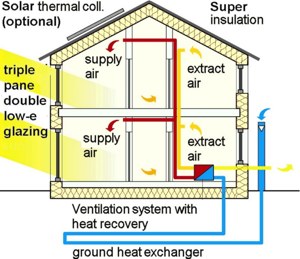
Passive House is a performance
based building standard that can result in a house that consumes as
little as 10% of the total heating and cooling energy used by a house
built to the 2006 building code.
To achieve it's impressively low
levels of energy consumption, certified
Passive House rely on proper solar orientation, an airtight envelope,
lots of insulation, mechanical ventilation, and the reuse of heat.
The Passive House standard
originated from a conversation in May 1988
between Professors Bo Adamson of Lund University, Sweden,
and Wolfgang
Feist of the Institut für Wohnen und Umwelt
(Institute for Housing and the Environment).
After the concept had been
validated at Darmstadt, with space heating
90% less than required for a standard new building of the time, the
'Economical Passive Houses Working Group' was created in 1996. This
developed the planning package and initiated the production of the novel
components that had been used, notably the windows and the
high-efficiency ventilation systems.
For European passive construction, prerequisite to this capability is an
annual heating requirement that is less than 15 kWh/(m²a) (4755 Btu/ft²/yr), not
to be attained at the cost of an increase in use of energy for other purposes
(e.g., electricity). Furthermore, the combined primary energy
consumption of living area of a European passive house may not exceed 120
kWh/(m²a) (38039 Btu/ft²/yr) for heat, hot water and household electricity.
With this as a starting point, additional energy
requirements may be completely covered using renewable energy sources.
Following are the basic features that distinguish
passive house construction (for Central Europe climate):
Compact form and good
insulation
All components of the
exterior shell of the house are insulated to achieve a U-factor that does not
exceed 0.15 W/(m²K) (0.026 Btu/h/ft²/°F).
Windows (glazing and
frames, combined) should have U-factors not exceeding 0.80 W/(m²K) (0.14
Btu/h/ft²/°F), with solar heat-gain coefficients around 50%.
Building envelope
air-tightness
Air leakage through
unsealed joints must be less than 0.6 times the house volume per hour.
Passive preheating of
fresh air
Fresh air may be brought
into the house through underground ducts that exchange heat with the soil. This
preheats fresh air to a temperature above 5°C (41°F), even on cold winter days.
Highly efficient heat
recovery from exhaust air using an air-to-air heat exchanger
Most of the perceptible
heat in the exhaust air is transferred to the incoming fresh air (heat recovery
rate over 80%).